Higher Education Funding
I wrote this paper, as a part of my Fellowship of the Higher Education Academy in University of Exeter. A comment was to try and publish it to wider audience. So I decided to publish it here.
In this blog post, I aim to shed light on the pressing issue of higher education funding in the UK. As an academic, I believe that this issue is of great importance. The current funding model is unsustainable, and I will illustrate how this problem affects two universities that I am familiar with: the University of Kent, where I completed my PhD, and my current institution, the University of Exeter.
Introduction
Higher education provides a wide range of benefits to individuals, society, and the economy. It offers a platform for individuals to acquire in-depth knowledge, critical thinking skills, and intellectual development, enabling them to contribute to their fields of study and society as a whole. Additionally, college and university experiences promote personal growth and self-discovery, allowing individuals to explore new interests, develop their identities, and cultivate important life skills such as time management, communication, and problem-solving.
Higher education plays a significant role in preparing individuals for their chosen careers. It equips them with specialized knowledge and skills relevant to their fields, enhancing their employability and expanding their career opportunities. Many professions require advanced degrees or specialized training that can only be obtained through higher education.
Moreover, higher education serves as a pathway for social mobility, enabling individuals from diverse backgrounds to access opportunities and improve their socioeconomic status. It promotes equality by providing a platform for individuals to overcome barriers and achieve their full potential, regardless of their socioeconomic, ethnic, or cultural background.
Universities and colleges also serve as hubs of research and innovation, contributing to advancements in various disciplines and generating new knowledge. Through research initiatives, higher education institutions address societal challenges and drive scientific, technological, and social progress.
Furthermore, higher education institutions function as cultural and social centers within communities. They foster diversity, multiculturalism, and social integration by bringing together students from different backgrounds and facilitating dialogue, understanding, and appreciation of various cultures, perspectives, and ideas.
Lastly, higher education plays a vital role in economic development. It produces a skilled workforce, fosters entrepreneurship and innovation, attracts foreign students, drives regional development through research and knowledge transfer, and contributes to the growth of industries and sectors that rely on specialized knowledge and expertise.
UK higher education is recognized as a global success story, reflecting a long history of strong academic communities. However, this sector has endured constant change over the past two decades, with fees losing value in England and differential funding regimes in the UK devolved administrations being the most significant reforms (McCann et al., 2019).
Following an extensive strike, UCU has successfully negotiated a 4-5% pay increase for staff members through ongoing discussions (UCU, 2023). However, UCU members may find this outcome underwhelming as it falls short of the initial promises made by the union. While the UCU Secretary asserts that the sector has the necessary funds (UCU, 2023), it is important to note that not all universities can currently afford to implement the pay increase. In fact, several universities, including the University of Kent and the University of East Anglia, have chosen to defer the pay increase by a year (Williams, 2023).
There is growing concern that the UK’s higher education funding system is broken (Weale, 2023). Vice-chancellors know that raising tuition fees would be politically unpopular, but with inflation and the cost of living crisis rising, funding for higher education is set to fall to its lowest level in real terms since the 1990s. The proportion of English universities reporting an in-year deficit has increased from 5% in 2015-16 to 32% in 2019-20. Universities have become increasingly reliant on fees from international students to balance their books. However, there are fears that the recent announcement on student visas could lead to a decline in international applications, which would further strain university finances.
Some universities could find themselves squeezed between the falling value of domestic tuition fees and declining overseas recruitment. This could lead to cuts in courses, staff and facilities, and could ultimately damage the quality of higher education in the UK.
In this report I will start by describing the current funding in the UK. I will then show two examples of universities financial from university of Exeter and university of Kent. I will then discuss some side effects of this financial situation in Higher education. I will talk about different models of funding in the world. I will then discuss how we can move from here.
Funding in the UK, history and current
The current funding model for higher education in the UK relies on a combination of government funding, student tuition fees, and income generated by universities through research and other activities.
The government provides funding to universities through various channels, including direct grants to institutions, research funding, andstudent loan financing. Additionally, universities generate income from the tuition fees paid by students, which are determined by the government.
In England, a significant reform was introduced to the higher education funding system, allowing universities to charge tuition fees of up to £9,000 per year (Callender, 2022). This amount was later increased to £9,250 for the 2017-18 academic year. Students have the option to borrow tuition fee loans and living cost loans from the government to cover their expenses during their studies. These lons are expected to be repaid once the graduates surpass a certain income threshold.
On the other hand, universities in Scotland are not allowed to charge fees for Scottish-based students. Instead, they receive funding from the government, averaging around £5,000 per student.
In Northern Ireland, universities charge local students £4,395, with additional funding provided by the Northern Ireland Executive, as compared to universities in England.
One of the most interesting changes in university policies in 2015/16 was the removal of caps on student numbers in England and Wales. This has significantly increased the competitive nature of the market to attract UK students. In contrast, student caps remain in place for local students in Scotland and Northern Ireland.
The tuition fee system in England is a source of political controversy and unpopularity among both students and universities. The £9,250 headline fee, which is currently worth £6,585 to universities, has not increased in real terms since it was introduced. Students are no happier about these fees now than they were when they were introduced, and the fee income available in Scotland, Wales, and Northern Ireland is even lower (Whiteley, 2023).
This financial strain is reflected in the financial data of universities. The proportion of English universities reporting an in-year deficit has increased from 5% in 2015-16 to 32% in 2019-20. The Public Accounts Committee has expressed serious concern about this increase, which it sees as a threat to the long-term financial health of the sector.
In English institutions, net operating cashflow has decreased from 8.4% of income in 2019-20 to 4.2% in 2020-21. Cashflow is a crucial part of long-term sustainability, so this decline is a further cause for concern.
While the government still provides funding to universities, there has been a substantial decrease in direct grants to institutions over the past decade. Consequently, universities have increasingly relied on tuition fee income and other sources of revenue to sustain their operations and invest in research and other initiatives. As a result, universities have become more dependent on international student enrollment, particularly those from non-EU countries.
Case study of University of Exeter
The University of Exeter has maintained a strong financial position despite the pandemic. In 2021, the university had a £28 million surplus, excluding a one-off charge for USS contributions. These contributions could be paid over the next 16 years and have been treated as a single accounting charge. The university was granted its royal charter in 1955 (of Exeter, 2023) and became a member of the Russell Group in 2012, signifying its status as a research-intensive UK university. By studying the financial management of a leading UK university like the University of Exeter, we can gain insights into its strategies.
In this section, we will examine the steps taken by the University of Exeter to ensure its financial stability within the current funding framework. We will begin by examining the growth in student numbers at the university. As shown in Figures 1-2 (of Exeter, 2022), the student population has increased by 31% from 2016 to 2022. This is aligned with the removal of the student cap numbers. However, this growth has not been reflected in the staffing numbers, which have only increased by 25% during the same period. This discrepancy highlights how staff numbers consistently lag behind student numbers.
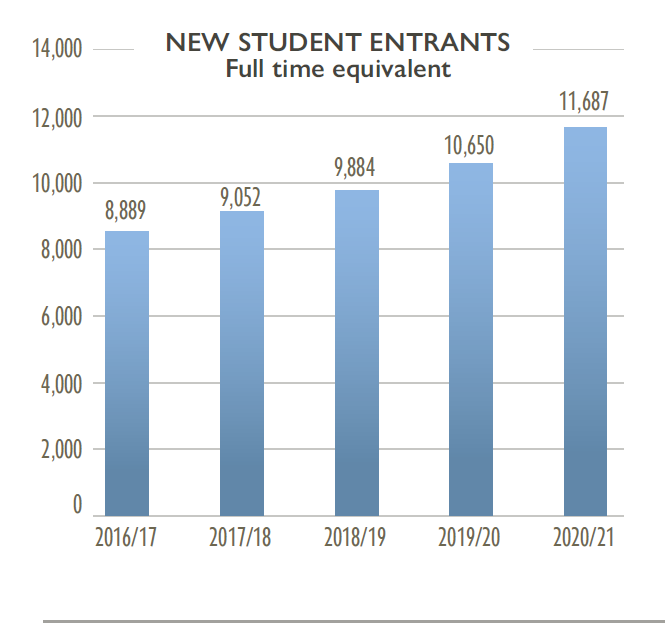
Figure 1: New Student Entrant number from the university of Exeter financial statment
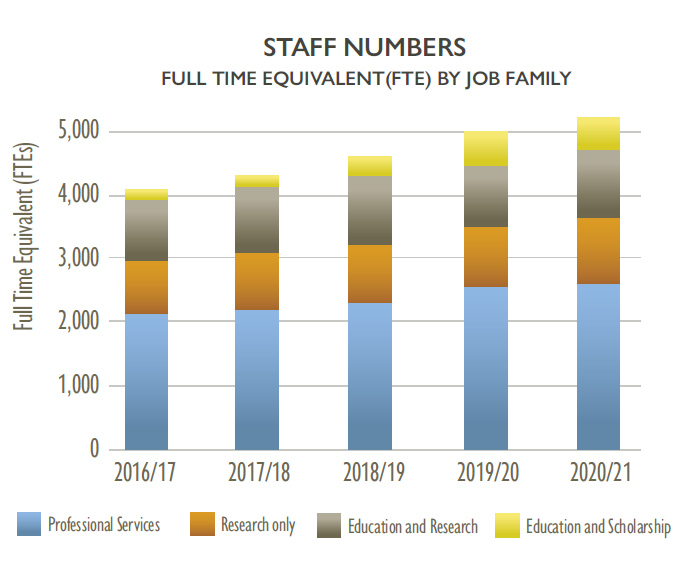
Figure 2: New Student Entrant number from the university of Exeter financial statment
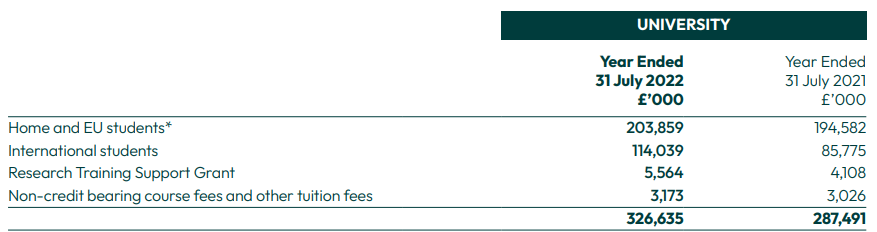
Figure 3: Income from the 2022 annual report from the university of Exeter financial statment
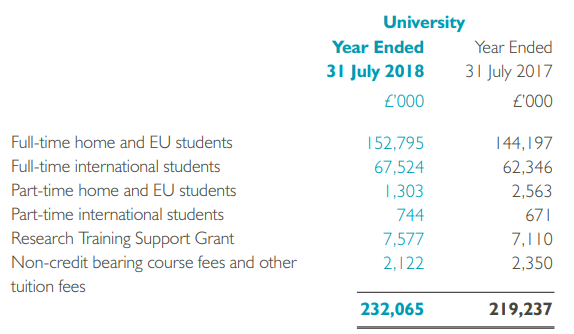
Figure 4: Income from the 2017 annual report from the university of Exeter financial statment
Another interesting aspect to explore is the recruitment strategies employed by universities, particularly the emphasis on attracting international students. This is evident in the income statements, which show a notable increase in the number of international students and a significant rise in income from this demographic. As shown in Figures 3-4 (of Exeter, 2022), income from international students has increased by approximately 67% . Moreover, university of Exeter has been criticised for its low pay compared to other south west universities as shown in average salaries by institution in the south west, plus % of salaries and pensions as proportion of income (Source (HESA, 2023)). As shown in table 1.
| University | Average wage | % of income goes to wages, pension and NI |
| Exeter | £40,427 | 52.3% |
| Bristol | £44,623 | 52.0% |
| Bath | £44,038 | 49.5% |
| Cardiff | £42,813 | 53.5% |
| Southampton | £46,828 | 49.7% |
| Plymouth | £41,580 | 53.2% |
| Bournemouth | £43,067 | 52.0% |
| Portsmouth | £43,442 | 56.5% |
Case study of University of Kent
The University of Kent has failed to sustain its financial position, with reported £11m in deficit, excluding the one-off charge for USS contributions. The university was granted its royal charter on 4 January 1965 (Martin, 1990) and it is a member of the Santander Network of European universities encouraging social and economic development.
In this section, we will reflect on how the current funding model has affected the University of Kent. One major difference is that Kent has not been increasing its student population, either in terms of domestic or international students. Figure 5-6 (of Kent, 2022) shows how the number of students has plateaued, with no increase in recent years. However, as you know, inflation and the depreciation of the pound mean that the same income cannot support the university as it used to.
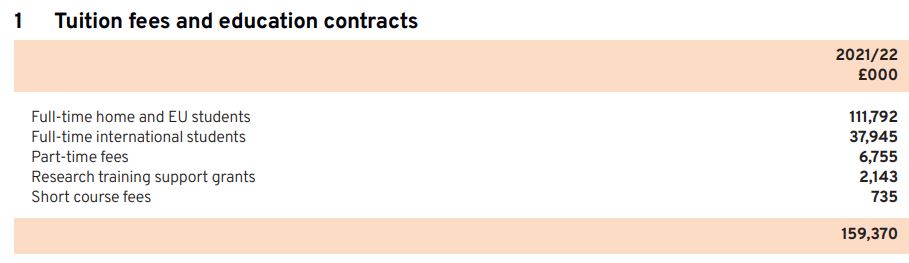
Figure 5: Income from the 2022 annual report from University of Kent financial statments
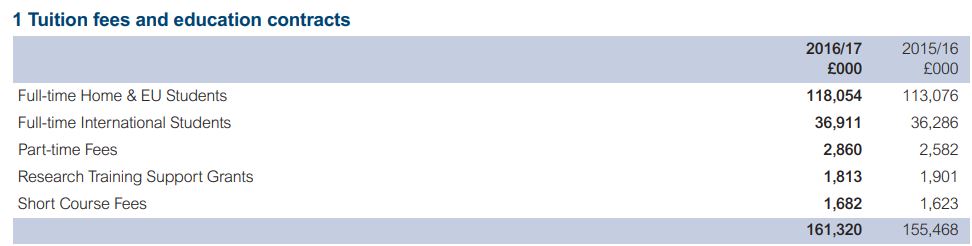
Figure 6: Income from the 2017 annual report from University of Kent financial statments
The University of Kent has been taking measures to address its financial challenges, such as closing campuses and offering voluntary redundancies, as indicated in the sources mentioned (Jee, 2023)(Carr, 2023). These actions are in response to the university’s £11 million deficit. However, it is important to recognize that these cost-cutting measures can have unintended consequences.
The decision to close campuses and offer redundancies may have an impact on the attractiveness of the University of Kent as a study destination. The reduction in physical infrastructure and potential changes in faculty composition can affect the overall student experience and perception of the institution. As a result, the university may face challenges in maintaining or attracting new students, leading to stagnating or falling student numbers. Finding a balance between financial stability and providing a high-quality education is indeed a challenging equation for universities. Cost-saving measures should be carefully evaluated to ensure that they do not undermine the university’s ability to deliver a valuable and appealing educational experience. Universities often face difficult decisions when trying to address financial deficits while simultaneously maintaining their reputation and academic standards.
Side effects UK higher education marketisation
The decline in government funding, increased reliance on student fees, and the removal of the cap on student numbers have led to the marketisation of the higher education sector. This has resulted in competition between institutions and greater uncertainty regarding future funding. These reforms, along with financial changes, have had an impact on the management and governance of universities, as observed by (Shattock, 2013).
(Shattock, 1999) (Shattock, 2013) argues that the instability in the external environment of higher education has accelerated the pace of change over the past decade and has led to the growth of a more centralized corporate managerial culture, contrasting with traditional university governance. This shift has moved away from the senate being the central governing body of UK universities to a transfer of power to the heads of institutions and senior executives.
The Lambert Report (Lambert, 2003) emphasized the government’s pressure on university governing bodies to adopt a more corporate board-like approach. This, coupled with the reorganization of academic structures (Shattock, 2013), has resulted in a general weakening of internal commitment by academics. The establishment of higher executive boards has also diminished the engagement of the university senate in policy formation and decision-making.
The term New Public Management (NPM) was initially coined by academics in the UK and Australia (HOOD, 1991) to describe a set of approaches developed during the 1980s. These approaches aimed to make the public service more business-like and enhance efficiency by adopting management models from the private sector. (Brown & Carasso, 2013) highlights how the UK government’s response to the higher education crisis was the wholesale adoption of NPM policies, and UK universities became the subject of “the most radical reform programme in the history of UK higher education and amongst the most radical anywhere".
Interestingly, a study by (Du & Lapsley, 2019) highlights how UK universities are unique in the intensity of their application of New Public Management (NPM) ideas and practices. This study used The Times Higher Education Supplement (THES) to study the effect of NPM to understand whether academe is preoccupied by a world of metrics and quantification. The results highlight how the concept of hybrid academic who straddles both academic subject and managements activities, such as head of subject groups, do not have a voice, power or influence. They concluded that New Public Management (NPM) has been the dominant paradigm in public sector management for over 30 years. However, NPM has not been as cost-effective as promised. In fact, they point out that the costs of running government have actually increased since NPM was introduced. This raises the question of whether the panoply of management reforms in UK universities has been cost effective.
Different funding options in the world
Different countries around the world have various approaches to funding higher education, and one significant aspect to consider is tuition fees (Jongbloed, 2008). There are four primary funding patterns observed globally. In many European countries, tuition fees are either low or non-existent. Canada and the Netherlands have government-regulated tuition fees, whereas in Australia, New Zealand, and the United Kingdom, the government sets a cap on tuition fees, but institutions have the authority to determine the specific fee amounts.
In the United States, tuition fees are present, with government-set fees for public universities and uncapped fees for private universities. The table 2 below provides a summary of these tuition patterns.
| Funding Pattern | Countries |
| No or low tuition fees | Most of Europe |
| Government-set tuition fees | Canada, Netherlands |
| Capped tuition fees | Australia, New Zealand, United Kingdom |
| Tuition fees, both government-set and uncapped | United States |
The United States model, which consists of government-set fees for public universities and uncapped fees for private universities. (Kahlenberg, 2015) provides a report that sheds light on the imbalances and challenges within the American higher education system. The report highlights the significant disparity in expenditure and income between prestigious private institutions like Princeton University and public community colleges such as Essex County College.
For instance, the report reveals a substantial contrast in subsidies per student, with Princeton University receiving a subsidy of $105,000 per student, while Essex County College only receives $2,400 per student. This stark difference illustrates the disparities in funding between private and public institutions in the United States.
The impact of such a funding model can lead to unattainable education for many students, as public institutions often struggle with limited resources and inadequate funding compared to their private counterparts. This disparity can contribute to unequal access to quality education and hinder social mobility for disadvantaged students.
In Canada, the provinces have the primary responsibility for funding post-secondary education. They control tuition fees, and their policies and political priorities determine overall capacity and spending on post-secondary education.Both the federal and provincial governments have the power to levy taxes, but the provinces raise almost as much revenue as the federal government. This is because the federal government transfers revenue to the provinces, and the provinces also receive equalization payments from the federal government (Feehan, 2014).
Tuition fees have increased in Canada since 2016 (Canada, 2023), but these increases may not fully meet the financial needs of universities. However, they help mitigate the impact of inflation on funding.
Additionally, Canada has been actively working to attract international students, which contributes to addressing funding gaps in higher education. The presence of international students not only brings diverse perspectives and experiences to Canadian universities but also generates revenue through tuition fees paid by these students.
Determining the amount of funding that each university should receive is a complex process, and several common approaches are employed. Four of the most prevalent approaches, as described by (Jongbloed, 2008), are outlined below. Table 3 provides a summary of these approaches.
| Approach | Key features | Advantages | Disadvantages |
| Planned, input-based funding | Allocates funding based on the number of students enrolled, the number of courses offered, and the cost of providing those courses. | Easy to administer. | Does not necessarily reward institutions for providing high-quality education. |
| Performance-based funding | Allocates funding based on the outcomes of an institution's educational programs. | Encourages institutions to improve their performance. | Can be difficult to measure performance accurately. |
| Purpose-specific purchasing | Allows institutions to compete for funding based on their ability to meet specific needs. | More responsive to the needs of students and employers. | Can be more complex to administer. |
| Demand-driven, input-based funding | Gives students vouchers that they can use to purchase educational services from any accredited nstitution. | Student-centered and can lead to increased competition among institutions. | Can lead to a decline in the quality of education if institutions are not properly funded. |
Planned funding, also known as negotiated funding, is a traditional approach where budget allocation is based on the previous year’s allocation of specific items. Representatives from educational institutions and funding authorities negotiate separate budget items, typically discussing cost projections and individual changes. This funding model is universally used in Europe.
Performance-based funding, on the other hand, allocates funds based on outcomes rather than inputs. This approach focuses on the achievement of specific criteria such as student exam pass rates or accumulated credits. Examples of this model include Denmark’s taximeter model and Sweden’s combination of enrolment numbers and credits.
Purpose-specific purchasing is a market-oriented approach where institutions compete for funding based on their ability to meet specific needs. Funding agencies select tenders that are the most price-competitive. This system encourages higher education institutions to compete in providing education, training, or research that fulfills national requirements. This is similar to the research grants that are provided by UK research councils.
Demand-driven, input-based funding involves providing students with vouchers that they can use to purchase educational services from accredited institutions. This student-centered approach fosters competition among institutions but may lead to a decline in education quality if institutions are inadequately funded.
The most suitable funding approach for universities depends on the unique circumstances of each country or region. It is crucial to carefully consider the advantages and disadvantages of each approach before making a decision.
Discussion
According to recent findings by Frontier Economics, universities in England make a significant contribution of approximately £95 billion to the economy and support over 815,000 jobs across the country (UUK, 2022). Given the immense importance of higher education in our lives and the future of our country, it is crucial to address the issues surrounding education funding. The current situation poses a potential risk of universities facing financial difficulties and even the possibility of closure if sustainable financial solutions are not implemented.
In 2021, university graduates in England earned an average annual salary of £36,000, which was £10,000 higher than the average salary for non-graduates. Individuals with postgraduate degrees earned an even higher average salary of £42,000, reflecting a difference of £6,000 compared to those with only undergraduate degrees (Statista, 2021).
The UK’s current higher education system has failed to be fully capitalized because universities are unable to set their own tuition fees. Additionally, the government has been reducing its financial support to universities. This has led to a situation where even a small increase in income, such as keeping pace with inflation, would help some universities with their financial problems.
Under the new student loan rules, set to take effect this year (Kirby, 2023), the repayment period for student loans is being extended from 30 years to 40 years. This change is expected to result in a higher percentage of students, around 52%, completing their loan repayments, compared to the previous rate of 23%. It is important to note that this alteration does not directly impact the income of universities but rather serves as a financial adjustment made by the government.
Furthermore, relying heavily on international students as the primary source of income for UK universities is not a sustainable approach. This is evident when considering the motivations of countries that send their students to the UK for education. These countries aim to develop their own academic institutions and, as a result, the number of students they send abroad is likely to decrease over time. We can already observe this trend with Chinese students, as China is increasingly prioritizing internal educational opportunities for its students. Therefore, it is essential for UK universities to seek alternative strategies for financial stability and not solely rely on international student enrollment.
An alternative perspective on the extended repayment period for student loans is that it increasingly resembles a form of graduate tax. This raises the question of whether it would be more beneficial to eliminate tuition fees entirely and instead implement a comprehensive graduate tax on all university graduates or increase general taxation. By adopting this approach, the tax base would expand to include individuals who have already graduated and did not take out loans, potentially increasing university income. This leads to the question of whether a hybrid model combining planned and performance funding could be implemented. Such a model could support the sustainability of many universities while still ensuring their role in promoting social mobility and long-term viability.
Abolishing tuition fees would democratize higher education, making it more accessible to people from all backgrounds. This could lead to improvements in the sector’s overall performance, as institutions would be able to focus on academic excellence rather than financial concerns.
The current model of top-down, performance-driven management was adoptedin response to financial pressures (Waring, 2017). However, research has shown that this model is no longer effective or appropriate. Abolishing tuition fees would remove this financial pressure, allowing academics to take back control of their institutions and develop new and innovative ways of managing them.
Critical Reflection
As academics navigating the turbulent higher education environment, it is essential to grasp the multifaceted challenges that confront the sector. The goals put forth by the University and College Union (UCU), particularly those related to fair pay and balanced workloads, resonate strongly with me. However, it is crucial to acknowledge that these objectives may not be immediately feasible for all universities given their specific circumstances. While I believe that the University of Exeter should take steps to address employee concerns, such as considering adjustments to staff salaries, I also understand that other institutions, like the University of Kent, may face constraints that hinder the immediate implementation of pay rises.
In addition to advocating for fair treatment within our universities, it is imperative for academics to enhance the effectiveness of their voices and principles within the management and governance structures. Establishing a robust and inclusive Senate can serve as a pivotal mechanism for facilitating meaningful discussions and proactive measures to address the challenges of the current environment. By fostering an environment of collaboration and open dialogue, universities can better navigate the complexities they face.
Furthermore, it is our collective responsibility as academics to not only educate our students but also the wider public on the paramount importance of higher education within the UK. We must emphasize how the current funding model jeopardizes vital components of this sector. Byraising awareness and promoting the value of higher education, we can garner support and work towards a more sustainable and inclusive funding model. While we strive to address the immediate issues faced by the current generation, it is equally crucial to invest in long-term solutions through education and advocacy to safeguard future generations from similar challenges.
In conclusion, as academics, we must actively engage with the challenges present in higher education. This entails understanding the limitations and opportunities within individual universities, advocating for fair treatment and balanced workloads, fostering inclusive governance structures, and educating the public on the significance of higher education. By doing so, we can collectively work towards a stronger and more sustainable future for the sector, ensuring its continued vitality and contribution to society.
References
-
UCU. (2023). HE negotiations 2023-24. https://www.ucu.org.uk/article/12681/HE-negotiations-2023-24
-
UCU. (2023). Biggest ever university strikes set to hit UK campuses over pay conditions and pensions. https://www.ucu.org.uk/article/12609/Biggest-ever-university-strikes-set-to-hit-UK-campuses-over-pay-conditions–pensions
-
Williams, T. (2023). UEA postpones staff pay rises as deficit grows. https://www.timeshighereducation.com/news/uea-postpones-staff-pay-rises-deficit-grows?fbclid=IwAR2iaElbJ3dnPxeYJh8MyXU-r3KTLEWrfYQmjBvyAlmq0GbOI_gYR3KUzx0
-
Kirby, J. (2023). Student finance: Three changes you should know about. https://www.thetimes.co.uk/money-mentor/article/student-finance-uk-latest-news-2023-changes-england-wales/.
-
Weale, S. (2023). Funding model for UK higher education is ‘broken’, say university VCs. https://www.theguardian.com/education/2023/may/31/funding-model-for-uk-higher-education-is-broken-say-university-vcs
-
HESA. (2023). HESA Table 12 and 14. https://www.hesa.ac.uk/data-and-analysis/finances/table-12
-
of Exeter, U. (2023). University of Exeter. http://www.exeter.ac.uk/about/facts/history/
-
Jee, A. (2023). University of Kent to shut Brussels campus. https://www.kentonline.co.uk/kent/news/university-forced-to-shut-brussels-campus-285065/
-
Carr, M. (2023). University of Kent opens voluntary redundancy scheme amid financial difficulties. https://www.kentonline.co.uk/kent/news/cash-strapped-uni-looks-to-cut-staff-amid-falling-student-nu-282134/
-
Whiteley, A. (2023). Opening the national conversation on university funding. https://www.universitiesuk.ac.uk/what-we-do/policy-and-research/publications/opening-national-conversation-university
-
Canada, S. (2023). Tuition fees for degree programs, 2022/2023. https://www150.statcan.gc.ca/n1/daily-quotidien/220907/dq220907b-eng.htm
-
UUK. (2022). Huge economic contribution of universities must not be forgotten. https://www.universitiesuk.ac.uk/what-we-do/creating-voice-our-members/media-releases/huge-economic-contribution-universities.
-
of Kent, U. (2022). Annual Report and Financial Statements of University of Kent. https://www.kent.ac.uk/finance/financial-statements
-
of Exeter, U. (2022). Annual Report and Financial Statements of Univertsity of Exeter. https://www.exeter.ac.uk/departments/finance/aboutus/financialstatements/#a
-
Callender, C. (2022). Undergraduate Student Funding in England: The Challenges Ahead for Equity. In Equity Policies in Global Higher Education: Reducing Inequality and Increasing Participation and Attainment (pp. 117–141). Springer International Publishing Cham.
-
Statista. (2021). Average annual salary of graduates and non-graduates in England from 2007 to 2021. https://statista.com/statistics/1191970/annual-salary-of-graduates-in england/#: :text=University%20graduates%20in%20England%20had,average%20salary%20for%20non-graduates.
-
Du, J., & Lapsley, I. (2019). The Reform of UK Universities: A Management Dream, An Academic Nightmare? Abacus, 55(3), 452–482. https://onlinelibrary.wiley.com/doi/abs/10.1111/abac.12167
-
McCann, L., Hutchison, N., & Adair, A. (2019). External funding of major capital projects in the UK Higher Education sector: issues of demand, supply and market timing? Journal of Property Research, 36(1), 97–130. https://doi.org/10.1080/09599916.2019.1590453
-
Waring, M. (2017). Management and leadership in UK universities: exploring the possibilities of change. Journal of Higher Education Policy and Management, 39(5), 540–558.
-
Kahlenberg, R. D. (2015). How higher education funding shortchanges community colleges. Higher Education Policy for Minorities in the United States.
-
Feehan, J. P. (2014). Canada’s equalization formula: peering inside the black box... and beyond. And Beyond (September 9, 2014). SPP Research Paper, 07.24.
-
Shattock, M. (2013). University governance, leadership and management in a decade of diversification and uncertainty. Higher Education Quarterly, 67(3), 217–233.
-
Brown, R., & Carasso, H. (2013). Everything for sale? The marketisation of UK higher education. Routledge.
-
Jongbloed, B. (2008). Funding higher education: a view from Europe. Center for Higher Education Policy Studies, 6.
-
Lambert, R. (2003). Lambert review of business-university collaboration. University of Illinois at Urbana-Champaign’s Academy for Entrepreneurial Leadership Historical Research Reference in Entrepreneurship.
-
Shattock, M. (1999). Governance and management in universities: The way we live now. Journal of Education Policy, 14(3), 271–282.
-
HOOD, C. H. R. I. S. T. O. P. H. E. R. (1991). A PUBLIC MANAGEMENT FOR ALL SEASONS? Public Administration, 69(1), 3–19. https://onlinelibrary.wiley.com/doi/abs/10.1111/j.1467-9299.1991.tb00779.x
-
Martin, G. (1990). From Vision to Reality: the Making of the University of Kent at Canterbury. University of Kent at Canterbury.